
TOY CRANE / History of claw machines
A Short History of the Claw Machine
Picking up a prize with a claw is a simple idea that has held people’s attention for more than a century. Here is how the claw machine became what it is today.
It started with the steam shovel
The claw machine’s roots go back to the United States in the early 1900s. Steam shovels were in the news — the digging of the Panama Canal made them famous — and coin-operated amusement machines imitated them. Players worked a tiny shovel inside a glass case with handles to scoop up sweets or trinkets. The machines were purely mechanical, but the thrill of lifting the prize yourself was the same as today.
A carnival favourite
In the 1920s and 1930s these “diggers” spread through amusement parks, travelling carnivals, railway stations and arcades, with candy and small toys as prizes. In some places their closeness to gambling caused regulatory debates, which is one reason operators stressed that the machines were games of skill.
Japan’s UFO Catcher and plush prizes
In the 1980s, Japan transformed the claw machine. Large transparent cabinets, bright lighting and a two-button control — move across once, move back once — became standard, and prizes shifted from sweets to character plushies. Machines like the famous UFO Catcher became the face of game centres and created a whole culture of collecting plush prizes.
Korea’s claw-machine boom
In Korea, claw machines outside arcades and stationery shops were a familiar sight for decades. In the mid-2010s dedicated claw-machine shops opened on almost every street, sparking a nationwide craze along with debates about claw strength and odds and a wave of “pro player” strategy videos.
How a real machine works
A modern machine moves the claw on a gantry with motors and lowers it on a cable. The grip comes from current flowing through a solenoid, and many machines let operators change that strength during the lift. That is why, on real machines, reading a prize’s position, centre of mass and hook points matters so much.
Claw games on screen
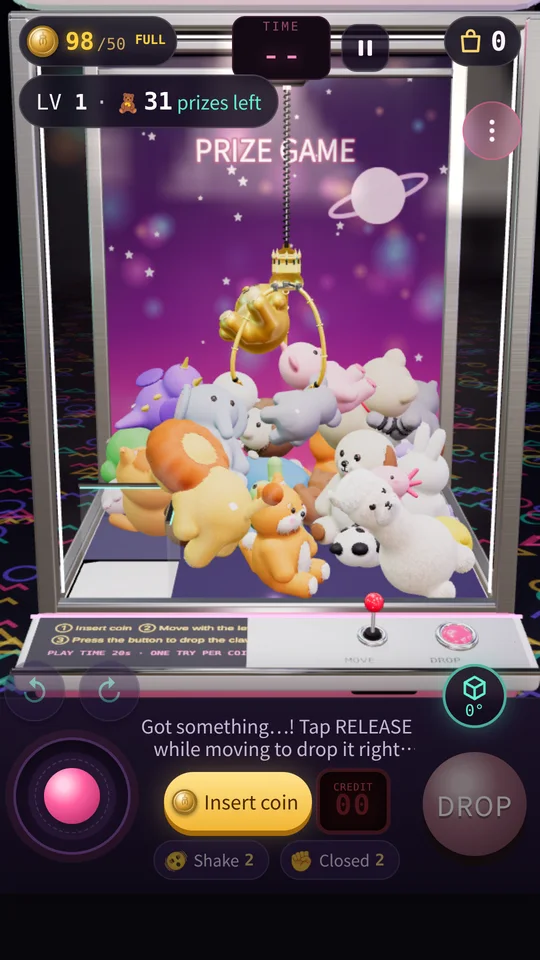
The smartphone era brought two kinds of digital claw games: remote-play services that let you steer a real machine over a camera, and mobile games that recreate the machine on screen. TOY CRANE takes the second path, but instead of fixed odds it moves fluffy plushies and the claw with a physics engine to recreate prizes that grab — and slip — like the real thing. It is our attempt to rebuild, with today’s technology, the simple joy those century-old steam-shovel machines offered.