
TOY CRANE / Grabbing by shape
Grabbing by Shape — Plush Animals, Round Plushies, Long Plushies, Balls, Boxes and Toys
Where you grab depends completely on the prize's shape. The approach that lifts a teddy bear every time will send a ball flying out of the claw.
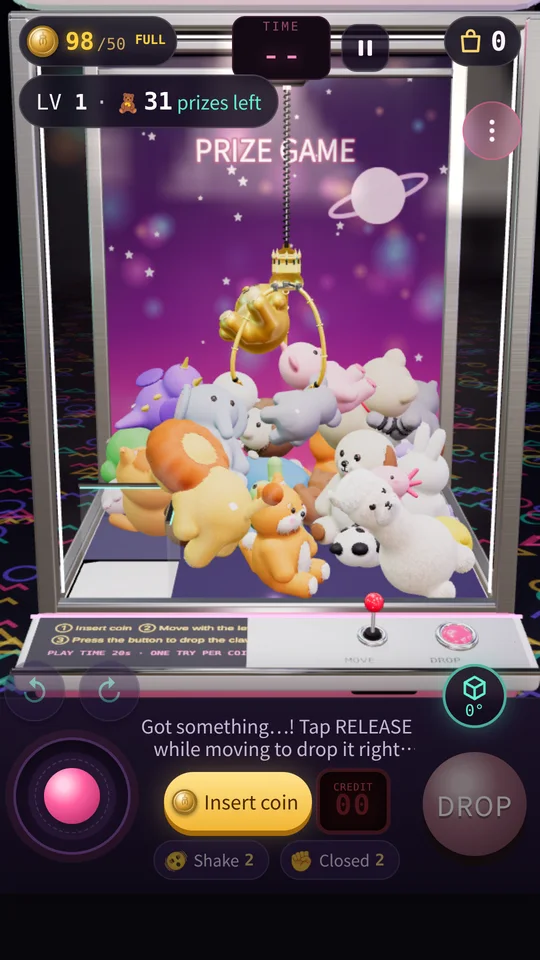
1. Why shape matters
It looks as if the claw squeezes a prize and lifts it, but most successful grabs actually hook the prize. A prong tip slips under something, or catches on a part that sticks out, and that is what holds it on the way up. Squeeze alone is weaker than you would think.
In TOY CRANE, plushies are simulated as chains of soft spheres. Round bodies let prongs slide off; arms, legs, ears and tails give them something to catch. Change where you aim for each shape and your success rate changes with it.
2. Animals with limbs and ears
Bears, bunnies, pandas, foxes, puppies, shibas, koalas, monkeys, lions and elephants are the friendliest prizes — learn the basics here.
- Aim between neck and arms. The neck is slightly narrower, so the prongs wrap it well, and a prong under an armpit turns the arm into a latch.
- Sitting plushies: drop just above the line between head and body so the claw cups the head and the tips settle under the shoulders.
- Don't grab only the ears. Long ears lift the plush, but the body dangles and swings hard on the carry. Treat ears as a bonus hook; keep the claw centred on the head or neck.
- Between the legs works on plushies lying on their back — one prong between the legs supports the hips.
If a bear lies face down, aim slightly head-side of the middle of its body so prongs slide under both arms. More in centre of mass.
3. Round plushies
Hamster, chick, strawberry, cloud, star, ghost and mushroom have little to hook, so prongs tend to slide up and off.
- Dead centre is everything. Slightly off and only one prong touches, pushing the plush sideways. Check both the front and side views (views and aiming).
- Use gaps underneath. A gap under the plush lets a tip get beneath it; one pressed against a wall leaves nowhere for the wall-side prong.
- Mushroom and ghost are wide on top and narrow below — aim for the narrow part under the cap so the cap acts as a latch.
- Star: a prong in the notch between two points catches surprisingly well.
Rubber Grip suits round plushies thanks to its high-friction pads; Mini Pinch works for small ones.
4. Long plushies: whale, shark, axolotl, seal
Grab one end of a long plush and the other end sags like a seesaw until it slides free.
- Grab slightly towards the heavy end. Whales and sharks are bulky at the head and slim at the tail, so the true balance point sits a little head-side of the middle.
- Think about prong direction. Two prongs across the body and one opposite is the most stable arrangement; the red back prong tells you which way the claw faces.
- Fins and frills are hooks. A shark's dorsal fin or an axolotl's gill frills reduce slipping.
- Long prizes swing a lot in transit, so prefer the ones already near the chute.
Long Reach wraps large long plushies well, but its grip is weaker, so drop deep enough for the prongs to get underneath.
5. Balls
Tennis balls, soccer balls, basketballs, beach balls and bouncy balls are perfect spheres with nothing to catch. Think "support from below", not "squeeze".
- Compare ball and claw size. The tips must get below the ball's widest line. If they close above it, closing squeezes the ball upward and pops it out.
- Small balls: Mini Pinch, dead centre.
- Big balls are hard to wrap at all; near the chute, consider pushing them with No-Open.
- Balls roll. Clearing prizes around a ball sometimes sends it toward the chute by itself.
6. Boxes and capsules
Miniature boxes, gift boxes and capsule toys have flat, firm faces that prongs slide across.
- Grab across the corners. Prongs on a flat face slip; prongs wrapping corners catch. Rotate the view to see how the box sits and line the claw up diagonally.
- Tilted boxes: let the prong on the low side go deeper.
- Capsules behave like balls — centre and deep.
- Standing boxes are top-grabbed and bottom-heavy; often better to wait for them to fall over.
7. Toys: duck, car, cube, donut, robot, plane
- Rubber duck: the narrow neck catches like a plush animal's.
- Toy car: low and flat. Line two prongs along its sides and drop deep so tips slip under the wheels.
- Puzzle cube: like a box — corners, diagonally.
- Squishy donut: the hole is the best hook in the game. Confirm its position in the side view.
- Robot toy: aim for armpits and neck, but it is firm and gives less, so aim more precisely.
- Toy plane: balance is everything. Aim where wings meet body; tail or wingtip grabs nearly always fail.
This matters most around levels 201–300, where balls, toys and boxes appear. See also choosing a claw.